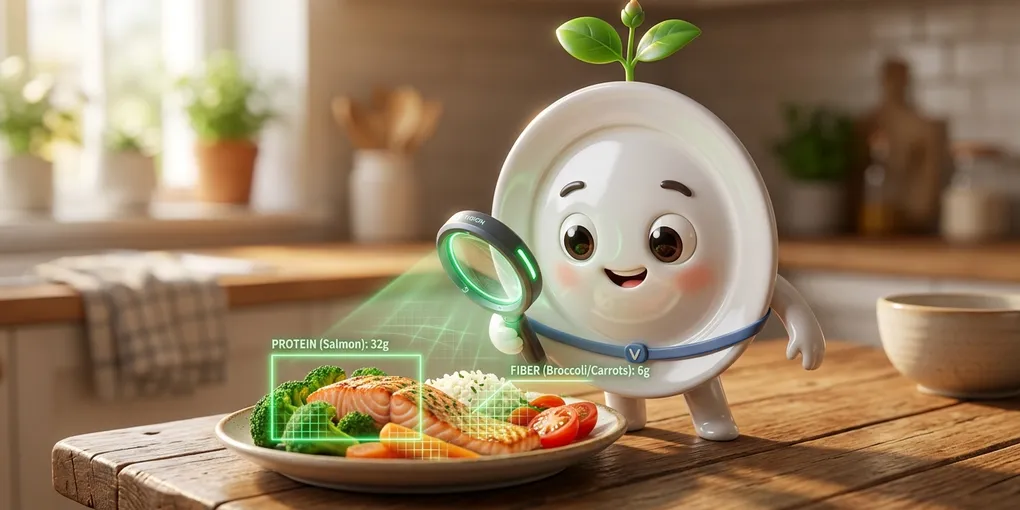
AI Food Recognition: How Computer Vision Replaces Kitchen Scales
How PlateTracker combines browser-side image compression, multimodal AI Vision, and deterministic USDA databases without hallucinations.
Just a few years ago, attempting to log a meal via smartphone camera felt like rolling dice: algorithms frequently confused oatmeal with scrambled eggs, and stew with lentil soup. But with recent breakthroughs in multimodal Vision-Language Models (VLMs), visual food tracking has reached unprecedented fidelity.
Today, multimodal computer vision identifies items on your plate while calculating spatial ratios and volume estimations. Here is an architectural look under the hood of PlateTracker.
1. Zero-Friction Client-Side Preprocessing
When you tap the camera button in PlateTracker, your phone does not upload a massive, uncompressed 8-15 MB photo over cellular networks:
- Browser Optimization: Using HTML5 Canvas and WebAssembly workers, the image is scaled to a standard 1,024 px bound and converted into WebP format right in your browser.
- Micro-Payload: File size drops to 120-180 KB, enabling sub-second uploads even on weak mobile LTE connections.
- Privacy First: Only the visual plate image is processed: GPS metadata, device identifiers, and personal telemetry are completely stripped.
2. Multimodal AI & Spatial Plate Segmentation
A fine-tuned multimodal vision pipeline processes the optimized image:
- Plate Boundary Detection: The model segments the outer rim of the plate and isolates individual food items.
- Volumetric & Density Estimation: Using shadows, textures, and relative overlap, the system estimates the visual proportion occupied by each food group.
- Harvard Metric Alignment: Food groups are mapped against the gold-standard Harvard Healthy Eating Plate method (1/2 veggies, 1/4 protein, and 1/4 whole grains) to yield a Meal Balance Score from 0 to 100.
3. The Deterministic Database Backstop (No Hallucinations)
The single greatest hazard of naive LLM usage in health technology is hallucination. A language model asked for calorie values might confidently claim that a bowl of rice contains 800 calories or 50g of protein with zero factual grounding.
PlateTracker prevents this using an architectural Database Backstop:
- The AI vision model is strictly constrained to visual recognition: identifying canonical food items (such as “baked Atlantic salmon”, “steamed quinoa”, “cucumber slices”) and approximate portion brackets.
- Nutritional breakdown is then retrieved deterministically from the standardized USDA FoodData Central database.
- Calorie and macro calculations are performed by deterministic math, completely eliminating AI numerical guesswork.
4. The 1-Tap Correction Loop
What if your plate has grilled halloumi cheese instead of tofu? You don’t need to re-run the entire pipeline. Tap the ingredient card or speak into your microphone to swap it instantly. PlateTracker recalculates your Plate Balance Score immediately on the client side.
Try It on Your Next Meal
Experience frictionless tracking without installing heavy app store binaries: head to tracker.platetracker.app and analyze your next lunch in under 3 seconds.
Sources
- USDA Agricultural Research Service: FoodData Central Database. https://fdc.nal.usda.gov/
- Harvard T.H. Chan School of Public Health: Healthy Eating Plate. https://www.hsph.harvard.edu/nutritionsource/healthy-eating-plate/
- Anthropic & Google DeepMind: Advances in Multimodal Vision-Language Models for Spatial Reasoning (2024).
Check Your Plate Balance by Photo
Snap your meal in PlateTracker. AI determines Harvard Plate proportions and nutrients in 3 seconds without scales.